You want thin slices of roast beef, but they come out uneven. When portioning a large piece of meat, you find yourself moving the knife back and forth repeatedly.
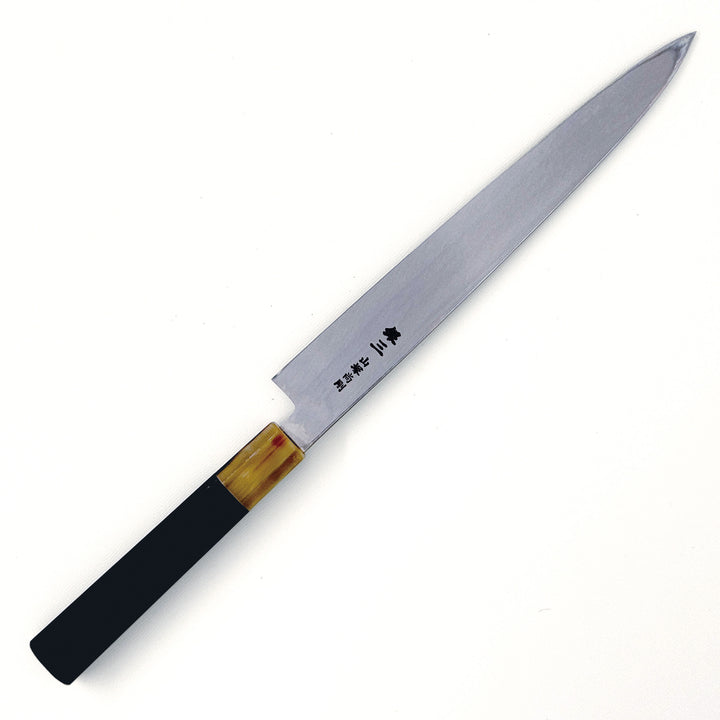
A sujihiki is one option for these tasks. Its long, narrow shape can also be useful in home kitchens where meat dishes and fish preparation are part of the cooking routine.
This guide explains what it does, how it differs from a gyuto and a yanagiba, and what to consider when choosing a length.
Sujihiki: a knife for trimming meat and slicing
A sujihiki is used for trimming sinew from meat and cutting larger pieces into portions.
Typical tasks include:
- Removing tough sinew and thin membranes from the surface of meat
- Slicing roast beef or ham thinly
- Slicing boneless fish for sashimi or carpaccio
Its defining shape is long and narrow. Here, blade width means the height from the cutting edge to the spine when the knife is viewed from the side.
A draw cut means sliding the blade towards you as you cut. Instead of only pressing straight down, you use the length of the edge to move through the food.
A sujihiki is well suited to this motion. It is useful when you want to portion food with fewer movements rather than many short sawing strokes.
How does it differ from a gyuto?
A gyuto is a versatile chef’s knife for meat, fish and vegetables. Although its Japanese name refers to beef, it is not only for beef.
A sujihiki focuses on jobs that make use of its long, narrow blade, such as trimming and slicing.
| Knife | Strengths and when to consider it |
|---|---|
| Gyuto | Everyday preparation, including chopping vegetables and cutting meat and fish. Consider it when you want one versatile knife. |
| Sujihiki | Trimming meat, portioning meat and fish, and thin slicing. Consider adding one for slicing tasks. |
If you already own a gyuto or santoku, think about which tasks are difficult with your current knife.
If you mainly chop vegetables, restoring the edge of your current knife is another option. If you often cut larger pieces of meat or roast beef, a sujihiki may fill a useful role.
How does it differ from a yanagiba?
A yanagiba is another long, slender knife, mainly used for slicing sashimi.
One key difference is the way the edge is formed.
A sujihiki is generally double-bevelled, with bevels on both sides of the cutting edge. This construction is also common on gyuto and santoku.
A yanagiba is generally single-bevelled, with the main bevel on one side. Right-handed and left-handed versions differ, so check before choosing.
Even a double-bevel knife may have a specified handedness because of its edge asymmetry or handle shape. Check the individual product specifications.
You can slice sashimi with a sujihiki, but it will not feel exactly like using a yanagiba.
If you want to cover meat dishes as well as portioning fish, consider a sujihiki. If sashimi is your main focus and you want a dedicated tool, consider a yanagiba.
For more detail, read our guide to single-bevel and double-bevel knives.
Should you choose 240 or 270 mm?
Blade length refers to the cutting blade; it does not include the handle, the part you hold.
240 mm is 24 cm, while 270 mm is 27 cm. The difference is 3 cm, but it affects both cutting room and manoeuvrability.
240 mm: when manoeuvrability matters
If you plan to use it on a home kitchen worktop, or are choosing a longer knife for the first time, start by considering 240 mm.
Its shorter length makes it easier to assess whether it fits your working space. The handle makes the overall knife longer than 24 cm, though, so do not judge by blade length alone.
270 mm: for more room when slicing larger ingredients
If you work with larger pieces of meat or want a longer drawing stroke, 270 mm is an option.
To make use of that length, you need room to move the knife forwards and backwards. Check the cutting board and the clearance from nearby dishes and walls.
What matters is that it suits the food you cut and the space where you work.
If you are unsure, measure your current knife and think about how much extra length you could comfortably manage.
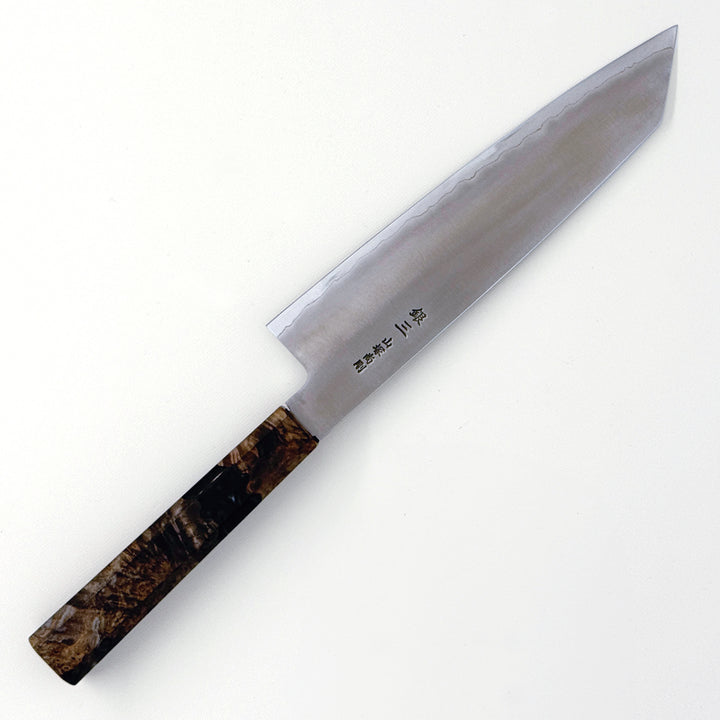
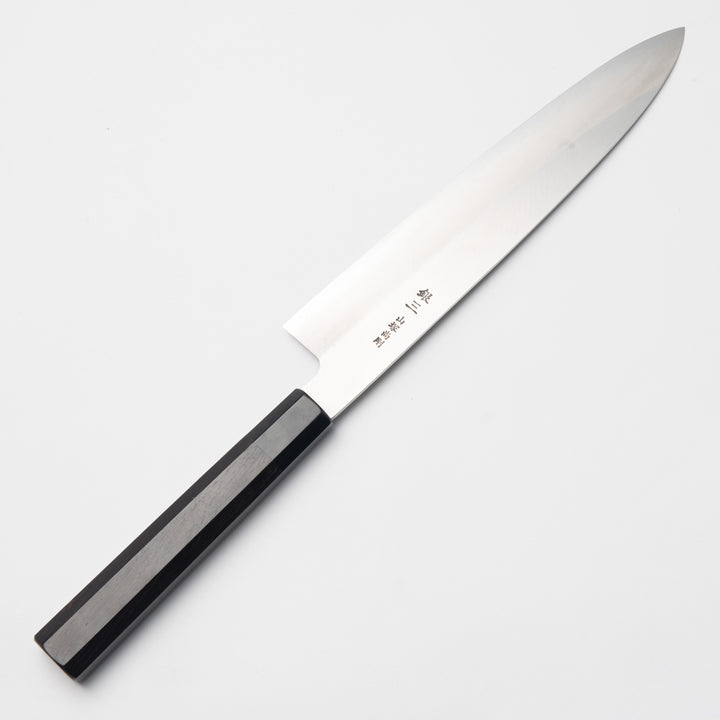
Yamatsuka’s Ginsan sujihiki knives
Yamatsuka introduces Ginsan sujihiki knives whose blacksmithing is carried out by Yamatsuka Shogo. Hand forging means heating the metal and hammering it into shape.
Ginsan is a stainless steel used for knife blades. It resists rust, but the knife still needs hand-washing and wiping dry before storage.
See the sujihiki collection for the sizes and specifications currently offered.
Explore Yamatsuka’s sujihiki knives
If you need help choosing, contact us. Tell us what you usually cook, which ingredients you slice, and the length of your current knife.