600 Years of Traditional Japanese Blacksmithing
The art of cutlery-making that thrives in Sakai, Osaka, is more than just an industry. It is a prayer—a prayer to pass on the very spirit of the Japanese people to the present day.
Its origins date back to the 5th century, to the era when iron tools were forged to construct the massive ancient burial mounds that still stand in this region today. Since then, generations of artisans have gathered here, honing their craft and weaving it unbroken into the future.
Holding a Sakai knife in your hand is not merely about owning a tool. It means cradling a piece of history in the palm of your hand. For 600 years, these blades have been the bedrock of Japanese culinary culture, earning the unwavering trust of top chefs around the world.
That pride lives on, undiminished, in every single knife.

Nihon Sankai Meibutsu Zue (Illustrated Guide to the Noted Products of Japan's Mountains and Seas)
Craftsmanship for the Select Few — Pride and Rarity
In an era where most knives circulating the market are mass-produced, Sakai knives stand in a class of their own. They account for only a tiny fraction of Japan’s total knife production. Yet, in the world of professional Japanese chefs—where unyielding aesthetics and extreme precision are absolute requirements—over 90% choose knives crafted in Sakai.
Refusing machine mass-production, master artisans breathe life into each knife by hand, naturally limiting the number that can be forged each year. This is precisely why a Sakai knife is far more than just a professional tool. For cooking enthusiasts who wish to enjoy supreme sharpness in their daily lives, as well as those seeking a genuine piece to treasure for a lifetime, Sakai remains a symbol of longing and trust. This rare "handful of authenticity," produced in strictly limited numbers, brings a profound sense of inspiration to your kitchen.
The Supreme Blade, Born of Divided Master Craftsmanship
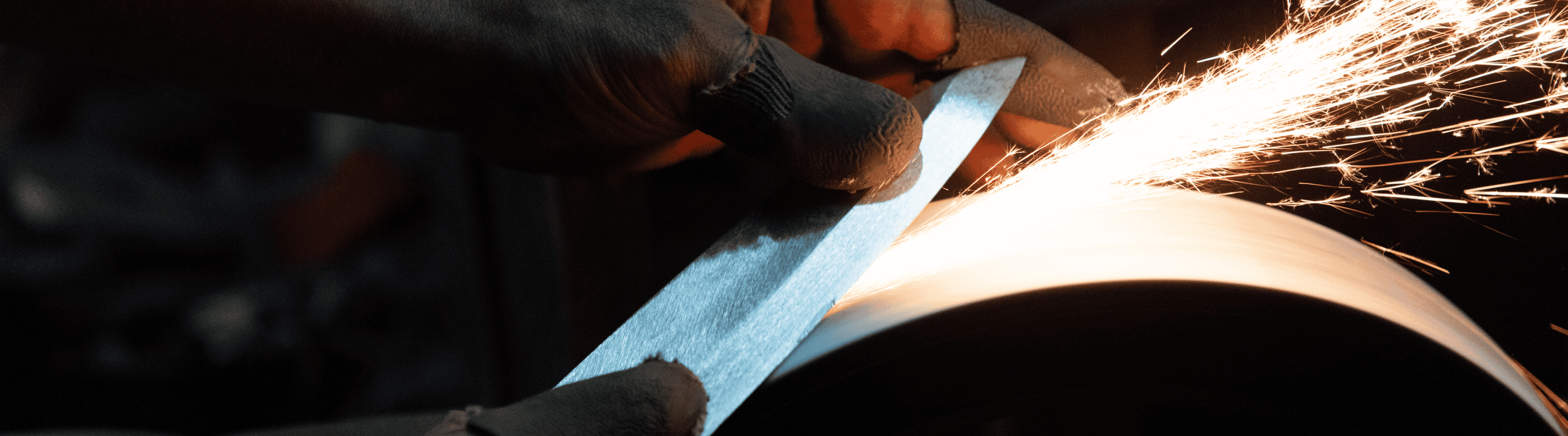
To master the kitchen, a mere "cutting tool" is not enough. One requires a blade of overwhelming presence, capable of elevating the very quality of the cuisine. Here, independent artisans who pledge their honor to their craft gather, forging a single knife to reach heights that no lone individual could ever attain. The blacksmith shaves away his own life, pouring his soul into every single strike. The sharpener permits not a single micron of error, honing the edge to absolute perfection. Each is a sovereign ruler of their own domain—and the clash of their obsessive, near-maniacal dedication is what gives birth to a sharpness so precise it leaves one breathless.
A blade that cleanly and smoothly severs the ingredients without crushing a single cell. A surface that gleams like a mirror, producing a cross-section brimming with life. That single stroke will dramatically transform the taste of your cuisine.
The beauty of the undulating wave pattern arising from the steel. A perfect balance that settles into your palm, as if custom-tailored solely for you. To hold a Sakai knife is not an act of mere consumption. It is the beginning of a profound relationship with your tool. The more it is used, the deeper the steel matures, developing a unique character that responds to the hand of its master.
With this knife, the quest for ultimate flavor begins. This is the very essence of Ajizanmai—a deep immersion into the world of taste.

The Harmony of Beauty and Strength — A Blade for a Lifetime
The tradition of blade making in Sakai, Osaka, resembles a sacred ritual. It is a profound endeavor to refine the Japanese spirit and seamlessly pass it down to a new era.
This craftsmanship has flowed uninterrupted since ancient times, when the colossal burial mounds were first constructed. In the 16th century, its exceptional quality earned the recognition of the Tokugawa Shogunate, which granted a special Goshuin (an exclusive seal of approval) solely to the artisans of Sakai. It was an honor that no other region could ever attain.
These are the hands of craftsmen who have gripped their tools for decades—hands etched with unimaginable passages of time and absolute dedication. These very hands stand as living proof of the unwavering trust won from the world’s greatest chefs.
What does it truly mean for a craft to be legitimately inherited? The answer lies right here.
