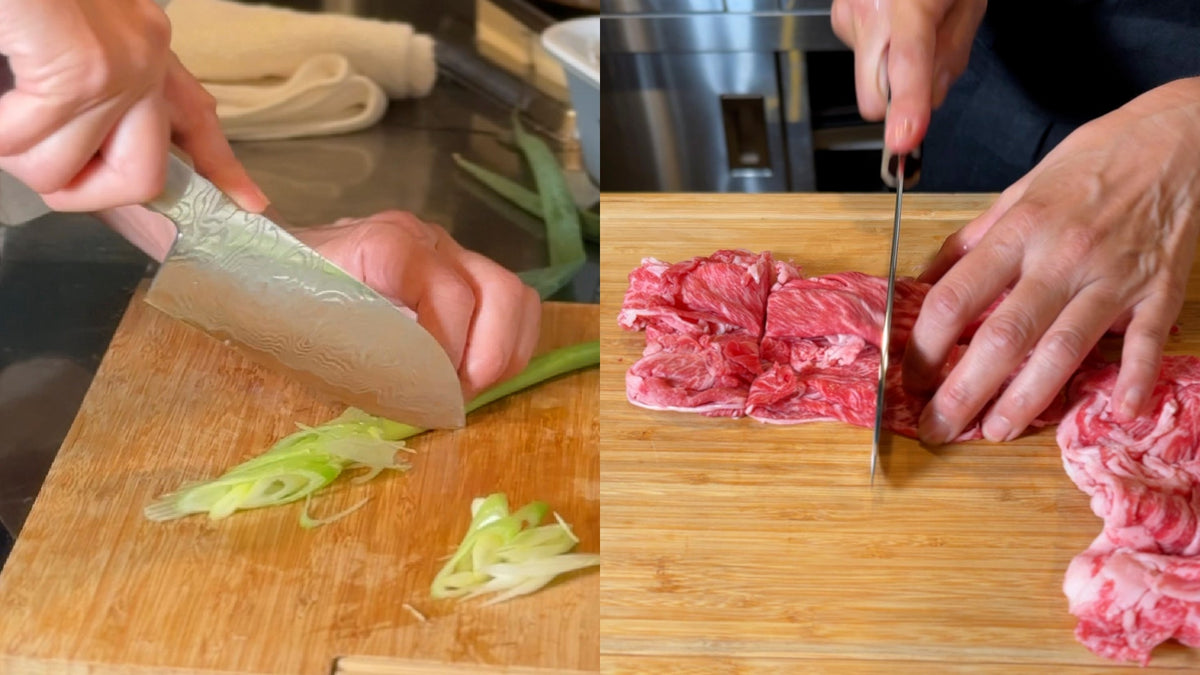
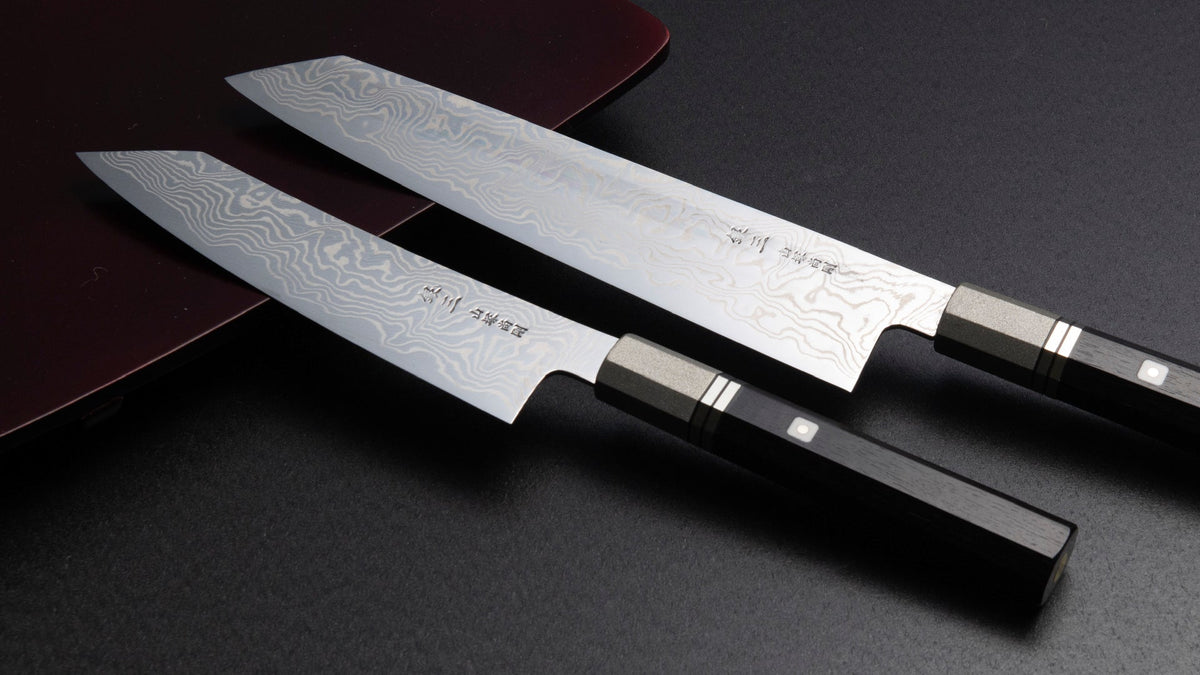
When choosing a premium Japanese knife, the first challenge is deciding which style (shape) to select and which size (blade length) fits you best.
While Japanese knifemaking encompasses various specialized shapes, three all-purpose styles stand as global favorites: the Santoku, the Gyuto, and the Petty.
Although they may appear similar at first glance, understanding their unique characteristics, optimal cutting styles, and sizing will dramatically transform your daily culinary experience.
Here is a comprehensive guide to help you discover the ideal lifelong companion for your kitchen.
1. The 3 Primary Models: Features and Differences
① Santoku — The Japanese All-Rounder

Named after the "Three Virtues" (cutting meat, fish, and vegetables), the Santoku is Japan’s iconic home kitchen knife. It features a softly rounded tip and a flatter edge toward the heel.
-
Best For: Straight downward vertical chopping ("push-cutting") utilizing the flat section of the blade.
-
Recommended If You:
-
Want a single versatile knife to handle daily home cooking.
-
Work in a kitchen with limited counter or cutting board space.
-
Prefer a traditional Japanese home cooking style.
-
② Gyuto — The Japanese Evolution of the Chef’s Knife

Originally introduced to Japan to carve beef, the Gyuto is the Japanese refined version of the Western chef's knife. It features a pointed tip and a subtle continuous curve along the edge. Like the Santoku, it excels with meat, fish, and vegetables.
-
Best For: Dynamic slicing techniques like "pull-cutting" or "rock-chopping" (pivoting the curved blade on the cutting board), as well as effortlessly slicing larger ingredients.
-
Recommended If You:
-
Frequently prepare large proteins, cabbages, or whole fish.
-
Enjoy smooth, fluid, and speedy knife work favored by professional chefs.
-
Prefer a longer blade that glides effortlessly through food.
-
③ Petty — The Master of Precision & Delicate Tasks
 The Petty is essentially a compact, nimble version of the Gyuto. Derived from the French word petite, it acts as an effortless extension of your hand.
-
Best For: Peeling fruits and vegetables, intricate garnishing, mincing garlic or herbs, and prepping small fish. Ideal for hand-held off-the-board tasks.
-
Recommended If You:
-
Seek a nimble "second knife" to complement your main Santoku or Gyuto.
-
Have smaller hands and feel intimidated by larger blades.
-
Want a quick, light tool for preparing breakfasts or small garnishes.
-
2. Choosing the Right Size (Blade Length)
After selecting the style, sizing is key. The ideal blade length depends on your hand size, kitchen workspace, and the size of your ingredients.
As a rule of thumb, a blade length that matches the distance from your inner elbow to your wrist offers the most natural control.
Recommended Blade Lengths
| Knife Style | Recommended Size | Ideal Usage & Target |
| Santoku | 165mm – 180mm | The Home Standard. Offers the best maneuverability for everyday domestic cooking. |
| Gyuto | 180mm – 210mm | Home & Enthusiasts. 210mm is the most popular size, balancing versatility and cutting range. |
| Gyuto | 240mm – 270mm | Pros & Collectors. Exceptional reach for slicing large proteins in single clean strokes. |
| Petty | 120mm – 150mm | 120mm excels at peeling/detail work; 150mm acts as a versatile mini-utility knife. |
3. Which One Should You Choose?
-
"I want a single knife to handle all my daily prep with ease."
👉 Santoku (165mm–180mm) or Gyuto (180mm–210mm)
-
"I cook meat frequently and want the fluid, effortless glide of a chef’s knife."
👉 Gyuto (210mm–240mm)
-
"I already have a main knife and need an ultra-nimble tool for detail work."
👉 Petty (120mm–150mm)
4. Forged by Master Blacksmith Shogo Yamatsuka
Once you have identified your ideal shape and size, the final step is quality and provenance.
Every knife from Yamatsuka.com is hand-forged in Ginsan Steel (Gingami No.3) by Sakai’s legendary master blacksmith, Shogo Yamatsuka.
Hand-hammered through extra painstaking steps, his blades achieve carbon-steel-like sharpness (HRC 60+) with remarkable edge retention—while offering pure stainless steel resistance to rust and zero flavor transfer to delicate ingredients.
Because every piece is 100% handcrafted, no two blades carry the exact same pattern or expression.
Choose the style that matches your culinary journey and experience a true lifelong masterpiece.