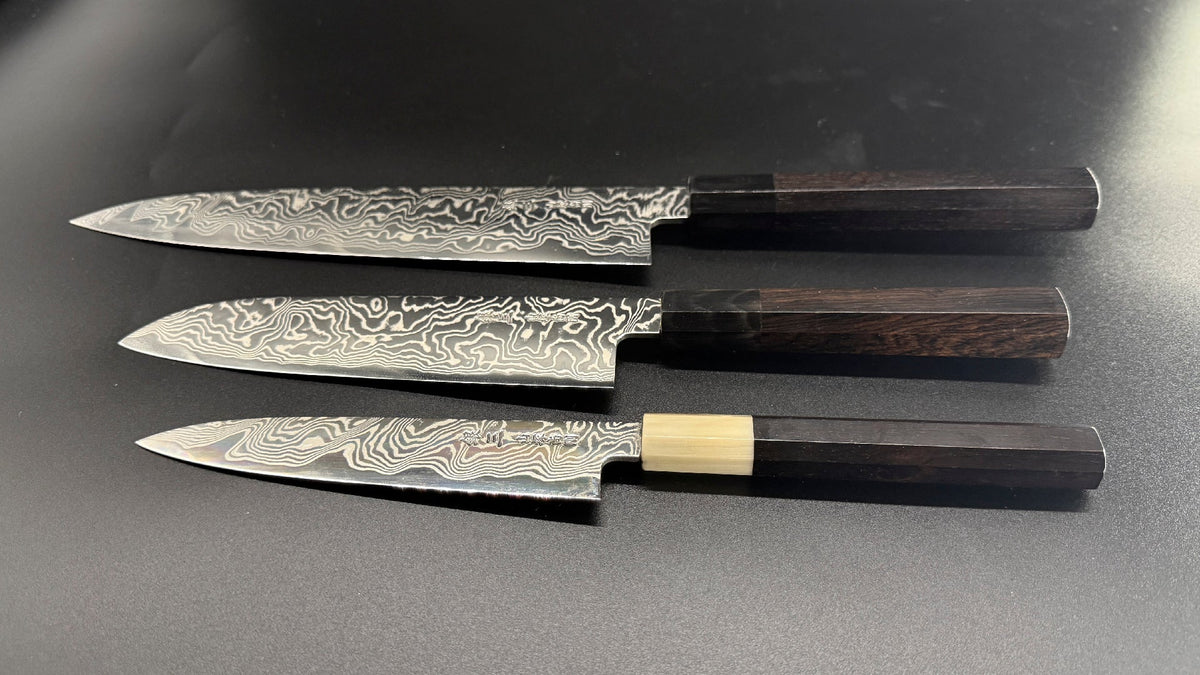
“I want to invest in a versatile Japanese knife, but should I choose a Santoku or a Gyuto?”
When selecting a Japanese kitchen knife, this is one of the most common questions we receive. While both are all-purpose knives designed to handle meat, fish, and vegetables effortlessly, they differ distinctly in blade shape, cutting dynamics, and historical roots.
From the perspective of master craftsman Shogo Yamatsuka in Sakai, Osaka, this guide breaks down the defining characteristics of each knife to help you find the perfect blade for your culinary style.
1. The Santoku: Versatile Wisdom Born from Japanese Home Cooking
The Santoku (三徳, literally meaning “three virtues”) was created in Japan during the early 20th century by fusing the traditional Japanese vegetable knife (Nakiri) with the Western chef knife (Gyuto). Its name reflects its capability to perform three essential tasks: slicing meat, prepping fish, and chopping vegetables.

-
Typical Blade Length: 165mm – 180mm (6.5" – 7.1", compact and maneuverable)
-
Blade Profile: Straight edge along the cutting line with a gently curved, downturned tip (Kamagata or sheep's foot tip)
-
Best For: Push-cutting vegetables, dicing, mincing, and portioning meats
【Why Choose a Santoku?】
Because the blade meets the cutting board with a flat, straight edge, it excels at clean push-cutting—slicing straight down through vegetables like cabbage or daikon without leaving uncut threads. The rounded tip makes it exceptionally safe and easy to handle, making it an ideal choice for home kitchens and compact prep spaces.
2. The Gyuto: The Global Standard Loved by Professional Chefs
The Gyuto (牛刀, literally “beef knife”) is the Japanese adaptation of the traditional Western chef’s knife. Highly revered worldwide under the name Gyuto, it stands as the global gold standard for multi-purpose culinary cutlery.

-
Typical Blade Length: 180mm – 240mm+ (7.1" – 9.5"+, offering extra reach)
-
Blade Profile: A graceful upward curve towards a sharp, pointed tip
-
Best For: Pull-slicing meats, filleting fish, delicate tip work, and carving
【Why Choose a Gyuto?】
The pointed tip offers precise control for delicate tasks like trimming meat, skinning fish, or making fine incisions. Thanks to its longer blade and curved belly, it allows for smooth pull-slicing—drawing the blade toward you in a single motion so that roast beef, sashimi, or proteins retain their cellular structure for a clean, glossy cut.
3. Santoku vs. Gyuto at a Glance
| Feature | Santoku Knife | Gyuto Knife |
| Origins | Japan (Fusion of Nakiri & Gyuto) | Western Chef Knife adapted in Japan |
| Common Lengths | 165mm – 180mm (Compact) | 180mm – 240mm+ (Standard to Long) |
| Edge Profile | Straight & flat edge | Curved belly with a sharp tip |
| Cutting Style | Push-cut (chopping straight down) | Pull-cut & Rocking motion |
| Best Ingredients | Vegetables, daily meal prep, smaller foods | Large cuts of meat, whole fish, precision slicing |
4. Which One Suits You Best? How to Choose
Since both knives are exceptionally versatile, the best choice depends on your personal cooking style and kitchen setup.
▼ Choose a Santoku if you:
-
Focus heavily on vegetable preparation and quick daily home cooking.
-
Work in a compact kitchen or use a smaller cutting board.
-
Prefer a lightweight, highly maneuverable knife with an easy-to-control tip.
▼ Choose a Gyuto if you:
-
Prepare large cuts of meat, trim proteins, or slice whole fish frequently.
-
Appreciate long, clean pull-cuts that produce beautiful, smooth food surfaces.
-
Enjoy dynamic, professional cooking techniques and want the extra blade length.
Conclusion: Bringing Lifelong Sharpness to Your Kitchen
Both the Santoku and Gyuto encapsulate centuries of Sakai blacksmithing heritage and thoughtful design.
At Yamatsuka, each blade is hand-forged in Sakai using premium rust-resistant Ginsan (Silver 3) stainless steel, adorned with stunning nickel Damascus patterns and luxury octagonal handles like Ebony with White Buffalo Horn.
Find the knife that feels like an extension of your hand, and elevate your daily cooking into an extraordinary ritual.